Showing posts with label hamstring injuries. Show all posts

Monday, January 23, 2012

Functional Hamstring Exercises

It is very important that the hamstrings are trained in same manner that they function during real life activities. The hamstrings work in synergy with multiple muscles and do not act as a singular isolated muscle. For example, to mimic hamstring muscle function during running the hamstrings need to be training in both open and closed kinetic chain movements. Closed chain exercise will mimic the stance phase of running, and open chain exercises can mimic the swing phase of running (eccentric actions).


  • Closed kinetic chain exercises – These are exercises where, in the case of the lower extremity, the foot is in constant contact with the ground. Examples would be: Lunges, squats, dead lifts, power cleans. These exercises focus on the co-contraction of multiple groups of muscles at the same time. They also involve multiple joints at the same time: those being the ankles, knees and hips.
  • Open kinetic chain exercises – These are exercises where the leg/foot is free to move and is not in contact with a surface. These exercises are usually non-weight bearing.
Numerous researchers recommend that your hamstrings should be 60 to 80% as strong as your quadriceps.
Strengthening Your Hamstrings
Strengthening your hamstrings is an essential component in reaching a full recovery from an injury. These are only a few of the strengthening exercises we recommend to our patients.

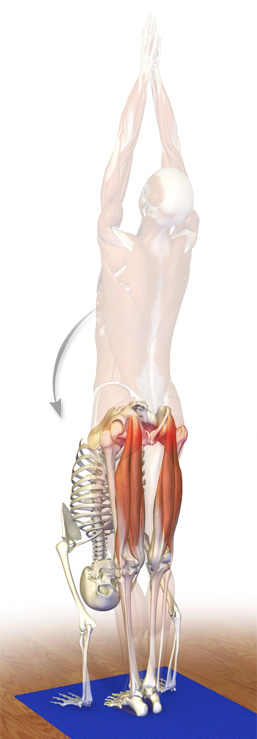
Romanian Dead Lift - This is a great closed kinetic chain exercise for training the hamstrings in eccentric contraction. Starting with low loads, for rehabilitation training, then building up to higher levels for athletic training.
· Stand straight with your lumbar spine in slight extension, with a barbell or dumbbells in your hands. Feet should be shoulder width apart, legs are straight, but not hyper extended.
· Flex forward from the hips moving the barbell or dumbbells down the front of your legs. Do not bend your knees all motion needs to come from the hips.
· As you lean forward, the hamstrings will lengthen, placing them under considerable eccentric load.
· Continue to lower the weight until you can no longer hold your back in the extension position. This will probably be when the weight is at the middle of your shins.

Single Leg Dead Lift – This is a similar exercise to the Romanian dead lift but is performed one leg at a time holding a dumbbell with both hands.
· The same procedure is used except that the back leg can be raised off of the ground for balance

B – Skip Drill
This is a common running drill that is great for strengthening the hamstrings (pawback). Follow this link to view a video on how to perform B-Skips. When doing this exercise, emphasis should be placed on pawing and driving the hip through. 


Stretching Your Hamstrings
Stretching after a hamstring injury is extremely important. Initially, stretching may have to be done passively within a pain free range of motion. To get a better idea of why stretching is so important, consider this. During the first two days to six weeks after an injury, collagen is formed and laid down to repair the injured area. If an injured person is performing the correct stretching exercises, the majority of the collagen will be laid down in the same direction as the tissue being repaired. This makes the repaired tissue stronger and more capable of performing its function. If the individual is not stretching, the tissue will be laid down in more random patterns, leading to the development of weaker tissue that is easily re-injured (scar tissue).

A word of caution, be careful not to be too aggressive with stretches after an injury. Do not stretch past the point of mild discomfort, doing so may delay healing and cause further injury.

Psoas Stretch
The psoas is a very important muscle to stretch if you have had a hamstring injury or wish to prevent one from occurring. There is an antagonistic relationship between the psoas muscle and your gluteal muscles. Essentially when the psoas become short and contracted it turns off your glute muscles. Your glutesand your hamstrings are your primary hip extensors. Therefore when your glutes get turned off, more of the load is placed on your hamstrings which then become susceptible to injury.

There are several ways that you can stretch out the psoas with either static or dynamic stretches.
Note: that after the psoas muscle is stretched out the gluteal muscles should be worked to regain activation of the muscle. This will help to take stress off of the hamstring.

Balance and Proprioceptive Training
Whenever a sprain/strain injury occurs it is not just the ligament, tendon, or muscle fibers that are damaged. Often, the embedded neurological structures within these soft-tissue structures are also damaged. These neurological structures (golgi tendon organs, muscle spindles, and joint receptors) are essential for postural control.
Both Golgi Tendon Organs and Muscle Spindle Cells are sensory neurons(proprioceptors). Sensory neurons monitor muscle and tendon motion (contraction and stretching) and relay this information back to your brain. This creates a feedback loop system that allows your body to discern its position and postural orientation. Joint receptors are located in joint capsules and respond to deep pressure and to other stimuli such as stress or change in position. They are also part of your body’s neurological feedback loop system.

What appears to be just a simple hamstring tear often involves some damage to several neurological structures. The good news is that the nervous system is very good at repairing itself given the right type of exercises.
That is why every patient that comes to us for a hamstring tear is also given exercises that involve balance training. Balance training helps to repair neurological damage, substantially decreasing the chance of re-injury


If you would like more information or to purchase our books please go to www.releaseyourbody.com . 

If you would like information about our clinic in Calgary Alberta please go to www.kinetichealth.ca.

(COPYRIGHT KINETIC HEALTH 2012 – ALL RIGHTS RESERVED)


References
  1. Boyle M. FunctionaL Training for Sports. Human Kinetics 2003. ISBN 073604681X.
  1. CooperDL, Fair J. Trainer’s corner: hamstring strains. Phys Sports Med1978; 8: 104.
  1. Croisier JL, Forthomme B, Namurois MH, Vanderthommen M, Crielaard JM. Hamstring Muscle Strain Recurrence and Strength Performance Disorders. Am J Sports Med 2002; 30(2) : 199-203.
  1. Garett W. The management of muscle strain injuries: An early return versus the risk of Recurrence. Clin J Sport Medicine 2002 12;3-5
  1. Heiser T, Weber j, Sullivan G et al prophylaxis & management of hamstring muscle injuries in intercollegiate football players. Am J sports med 12 : 368-370, 1984
  1. Jonhagen S, Nemeth G, Eriksson E. Hamstring Injuries in Sprinters: The Role of Concentric and Eccentric Hamstring Muscle Strength and Flexibility. Am J Sports Med 1994; 22(2): 262-266.
  1. SafranMR, Seaber AV, Garrett WE Jr. Warm-up and muscular injury prevention: an update. Sports Med1989; 8: 239–249
  1. SlocumDB, James SL. Biomechanics of running. JAMA1968; 205: 721–728.

Tuesday, September 28, 2010

Resolving Hamstring Injuries Part 5


Functional Hamstring Exercises
It is very important that the hamstrings are trained in same manner that they function during real life activities. The hamstrings work in synergy with multiple muscles and do not act as a singular isolated muscle. For example, to mimic hamstring muscle function during running the hamstrings need to be training in both open and closed kinetic chain movements. Closed chain exercise will mimic the stance phase of running, and open chain exercises can mimic the swing phase of running (eccentric actions).

  • Closed kinetic chain exercises – These are exercises where, in the case of the lower extremity, the foot is in constant contact with the ground. Examples would be: Lunges, squats, dead lifts, power cleans. These exercises focus on the co-contraction of multiple groups of muscles at the same time. They also involve multiple joints at the same time: those being the ankles, knees and hips.
  • Open kinetic chain exercises – These are exercises where the leg/foot is free to move and is not in contact with a surface. These exercises are usually non-weight bearing.
Numerous researchers recommend that your hamstrings should be 60 to 80% as strong as your quadriceps.

Strengthening Your Hamstrings
Strengthening your hamstrings is an essential component in reaching a full recovery from an injury. These are only a few of the strengthening exercises we recommend to our patients.

Romanian Dead Lift (Blog Photo) - This is a great closed kinetic chain exercise for training the hamstrings in eccentric contraction. Starting with low loads, for rehabilitation training, then building up to higher levels for athletic training.
· Stand straight with your lumbar spine in slight extension, with a barbell or dumbbells in your hands. Feet should be shoulder width apart, legs are straight, but not hyper extended.
· Flex forward from the hips moving the barbell or dumbbells down the front of your legs. Do not bend your knees all motion needs to come from the hips.
· As you lean forward, the hamstrings will lengthen, placing them under considerable eccentric load.
· Continue to lower the weight until you can no longer hold your back in the extension position. This will probably be when the weight is at the middle of your shins.

Single Leg Dead Lift – This is a similar exercise to the Romanian dead lift but is performed one leg at a time holding a dumbbell with both hands.
· The same procedure is used except that the back leg can be raised off of the ground for balance

B – Skip Drill
This is a common running drill that is great for strengthening the hamstrings (pawback). Follow this link to view a video on how to perform B-Skips. When doing this exercise, emphasis should be placed on pawing and driving the hip through. (Youtube Video of B-Skip Drill).

Stretching Your Hamstrings
Stretching after a hamstring injury is extremely important. Initially, stretching may have to be done passively within a pain free range of motion. To get a better idea of why stretching is so important, consider this. During the first two days to six weeks after an injury, collagen is formed and laid down to repair the injured area. If an injured person is performing the correct stretching exercises, the majority of the collagen will be laid down in the same direction as the tissue being repaired. This makes the repaired tissue stronger and more capable of performing its function. If the individual is not stretching, the tissue will be laid down in more random patterns, leading to the development of weaker tissue that is easily re-injured (scar tissue).

A word of caution, be careful not to be too aggressive with stretches after an injury. Do not stretch past the point of mild discomfort, doing so may delay healing and cause further injury.

Psoas Stretch
The psoas is a very important muscle to stretch if you have had a hamstring injury or wish to prevent one from occurring. There is an antagonistic relationship between the psoas muscle and your gluteal muscles. Essentially when the psoas become short and contracted it turns off your glute muscles. Your glutes and your hamstrings are your primary hip extensors. Therefore when your glutes get turned off, more of the load is placed on your hamstrings which then become susceptible to injury.

There are several ways that you can stretch out the psoas with either static or dynamic stretches.

Note: that after the psoas muscle is stretched out the gluteal muscles should be worked to regain activation of the muscle. This will help to take stress off of the hamstring.

Balance and Proprioceptive Training
Whenever a sprain/strain injury occurs it is not just the ligament, tendon, or muscle fibers that are damaged. Often, the embedded neurological structures within these soft-tissue structures are also damaged. These neurological structures (golgi tendon organs, muscle spindles, and joint receptors) are essential for postural control.
Both Golgi Tendon Organs and Muscle Spindle Cells are sensory neurons (proprioceptors). Sensory neurons monitor muscle and tendon motion (contraction and stretching) and relay this information back to your brain. This creates a feedback loop system that allows your body to discern its position and postural orientation. Joint receptors are located in joint capsules and respond to deep pressure and to other stimuli such as stress or change in position. They are also part of your body’s neurological feedback loop system.

What appears to be just a simple hamstring tear often involves some damage to several neurological structures. The good news is that the nervous system is very good at repairing itself given the right type of exercises.

That is why every patient that comes to us for a hamstring tear is also given exercises that involve balance training. Balance training helps to repair neurological damage, substantially decreasing the chance of re-injury

For more information, go to www.releaseyourbody.com
 If you would like information about our clinic please see http://kinetichealth.ca
(COPYRIGHT KINETIC HEALTH 2010 – ALL RIGHTS RESERVED)


References

  1. Boyle M. FunctionaL Training for Sports. Human Kinetics 2003. ISBN 073604681X.
  1. CooperDL, Fair J. Trainer’s corner: hamstring strains. Phys Sports Med1978; 8: 104.
  1. Croisier JL, Forthomme B, Namurois MH, Vanderthommen M, Crielaard JM. Hamstring Muscle Strain Recurrence and Strength Performance Disorders. Am J Sports Med 2002; 30(2) : 199-203.
  1. Garett W. The management of muscle strain injuries: An early return versus the risk of Recurrence. Clin J Sport Medicine 2002 12;3-5
  1. Heiser T, Weber j, Sullivan G et al prophylaxis & management of hamstring muscle injuries in intercollegiate football players. Am J sports med 12 : 368-370, 1984
  1. Jonhagen S, Nemeth G, Eriksson E. Hamstring Injuries in Sprinters: The Role of Concentric and Eccentric Hamstring Muscle Strength and Flexibility. Am J Sports Med 1994; 22(2): 262-266.
  1. SafranMR, Seaber AV, Garrett WE Jr. Warm-up and muscular injury prevention: an update. Sports Med1989; 8: 239–249
  1. SlocumDB, James SL. Biomechanics of running. JAMA1968; 205: 721–728.

Resolving Hamstrings Injuries Part 4


Myofascial Considerations
The previous list of structures focused on restrictions primarily in muscles, and their tendons. Another key area we must consider in any hamstring injury is fascia. Fascia is everywhere, weaving through, and interconnecting every component of our body.
Muscle fibers originate from, and insert into, fascial fibers. These fascial fibers, in turn, insert into multiple regions of the bone, and even into adjacent muscles. These additional points of contact and control provide the muscle with the ability to generate force in multiple directions.

Only certain sections of the muscle contract when performing an action. Force is not generated from just the origin and insertion points, but also through the numerous fascial connections.

Muscles work together as functional units that coordinate their actions across multiple joints. Depending on the degree of motion required, and amount of force that is needed, each muscle will contract only specific areas of the muscle, rather than the entire muscle. These very specific motions are largely coordinated by the neurological receptors embedded in the fascia, and not by the brain.
Fascia is full of two types of neurological receptors - mechanoreceptors and proprioceptors. A mechanoreceptor is a sensory receptor that responds to mechanical pressure or distortion. A proprioceptor is a sensor that provides the brain with information about joint angle, muscle length, and tension.


Motion is coordinated by the feedback of the neurological receptors in the fascia when tension is transferred from one area to the next. (Previously these receptors were only thought to be located within just the muscles).

Fascial Lines and a Hamstring Injury
When we evaluate a hamstring injury, we must also take into consideration all the fascial connections to the structures that are involved in performing and coordinating motion. It is important to look at the big picture, and take into consideration that multiple muscles, working across multiple joints (all of which are interconnected by fascia) are all required to coordinate these motions.

In the case of a hamstring injury, the fascial connections we should consider are in the Superficial Back Line (see Anatomy Trains by Thomas Meyers). The following is a short synopsis of the posterior line. I have also included a link to the Anatomy Trains dissection video about the posterior line – Thomas Meyers Superficial Back Line Video.

Superficial Back Line
Once you see these videos, you will find it very hard to dispute the importance of these fascial connections.

Bottom Line: You can try treating a hamstring injury with all the right techniques (ART, Graston, Massage etc.) and find that you still have not resolved a chronic problem you need to consider, and treat, the fascial interconnections

In part five of Resolving Hamstring Injuries we will cover Functional Hamstring Exercises.

If you would like more information or to purchase our books please go to www.releaseyourbody.com . 

If you would like information about our clinic in Calgary Alberta please go to www.kinetichealth.ca.

(COPYRIGHT KINETIC HEALTH 2012 – ALL RIGHTS RESERVED)

Monday, September 27, 2010

Resolving Hamstrings Injuries Part 3


Imaging a Hamstring Tear
X-Rays are only taken in a hamstring injury to rule out fractures (avulsion injury) and pathological processes. An X-Ray will not provide information about the actual tear.
The best imaging modality for viewing a hamstring injury is magnetic resonance imaging (MRI). Both computer tomography (CT) and ultrasound can be useful, but are not as definitive as an MRI. The advantage of ultrasound is the low cost.

Major sport teams often use MRI to determine if an athlete is going to recover from a hamstring injury. Research has shown that there is a direct correlation between the size and the number of tears seen on MRI imaging and the number of days that will be lost for athletes in competition.

Treatment of Hamstring Injuries

Initial Acute Injury
Right after the injury in the acute stage you should use RICE. RICE is an acronym for rest, ice, compression and elevation. If you have access to laser therapy this will also reduce the inflammation and speed the healing process.

Medication
NSAID’s are often immediately prescribed for hamstring injuries. For short periods of time, these mediations may be beneficial. Taking NSAID’s may not be the best advice if taken longer than seven days, as they can slow the healing response and decrease the overall quality of tissue leading to further injury.

Steroid injections at one time were often used to treat hamstring injuries, but these injections are no longer advised by many practitioners. Corticosteroids have been linked to poor healing, infections, and even ruptures of the tissue.

There are several natural alternatives that can be used to decrease inflammation without inhibiting the healing process or causing further injury. See our Blog on decreasing inflammation and speeding healing.

Start Treatment ASAP
  • Mobilization of the injured hamstring as soon as possible is essential in achieving a speedy recovery. This would include passive stretching and strengthening exercises that should be performed in a pain free range of motion.
  • Initially isometric strengthening exercises are recommended, followed by a gentle progression into isotonic exercises. Isometric exercises use static contraction of a muscle without any noticeable movement in the angle of the joint. In an isotonic exercise, tension remains unchanged but the muscle's length changes. An example would be weight lifting.
  • Upper body exercises should also be performed to maintain physical conditioning. Aerobic exercise should also be performed.
  • Aerobic exercise will speed the healing process by increasing cellular energy (ATP production) and increasing circulatory function. Improving circulation will increase oxygen input to the muscles and increase the removal of waste byproducts. Swimming is an excellent exercise for a hamstring injury (Stay within a pain free range of motion).
Manual Therapy
Manual therapy can reduce the formation of scar tissue and speed the overall healing. The longer that the injured person waits for therapy to begin the longer the resolution time may be.

The removal of any physical restrictions that form in the hamstrings, or other related areas, is essential for a full resolution. Some of these restrictions can be removed through the process of self-myofascial release (foam rollers, self massage, and gentle stretching). If the restrictions are severe enough then a manual therapy practitioner (ART, Graston, Massage) will be needed to break the restrictions.

It is important to note that any time a restriction is removed from one muscle, the antagonistic and synergist muscles must also be assessed for restrictions. This is a key point that many manual therapists overlook. For a full resolution of a hamstring injury, myofascial adhesions must be removed from the entire kinetic chain not just at the site of pain. Many of these restrictions will only be found with a more in depth biomechanical analysis and palpatory examination.

The following list of structures are common sites where restrictions are formed. These restrictions can form in a very short period of time. Common restriction sites are:

Hamstrings:
· Biceps Femoris (Long head - hamstring)
· Semimembranosis (hamstring)
· Semitendinosis (hamstring)
Antagonistic Muscles
Synergist Muscles

In part four of Resolving Hamstring Injuries we will cover Myofascial Considerations.

If you would like more information or to purchase our books please go to www.releaseyourbody.com . 

If you would like information about our clinic in Calgary Alberta please go to www.kinetichealth.ca.

(COPYRIGHT KINETIC HEALTH 2012 – ALL RIGHTS RESERVED)