Showing posts with label Brian Abelson. Show all posts

Friday, April 14, 2017

Motion Specific Release - MSR


What is Motion Specific Release - MSR


Motion Specific Release (MSR) is a hands-on evidence-based technique that recognizes the strength of merging diverse perspectives and methodologies to achieve optimum results. We now use MSR procedures everyday in our daily clinical practice to achieve incredible results. Motion Specific Release has evolved from a constant desire to improve our clinical outcomes and to help our patients get back to the fully functional life they want to lead. 

MSR is used to successfully treat a wide variety of musculoskeletal conditions-from head to toe. MSR is not your typical passive technique where the practitioner provides therapy, while the patient sits back and does nothing. MSR requires active participation of the patient in both therapy and during execution of prescribed exercises. 


The Evolution of MSR 


It has been over 25 years since I first started practicing as a musculoskeletal practitioner (MSK Practitioner). My entire career has been a constant process of education and evolution. After eight years of post-secondary education, I thought I knew quite a bit about the human body and how to help people, but in reality my knowledge base was very limit‐ ed, and my education was just beginning. 

Throughout my career I have been extremely fortunate to work with, and teach, alongside some great practitioners from a wide variety of health care disciplines in the MSK world. I have worked with amazing chiropractors, physiotherapists, medical practitioners, osteopaths, acupuncturists, myofascial release practitioners, registered massage therapist, kinesiologists, coaches, Olympic level and professional athletes, and some incredible personal trainers. Working with, and teaching, with these individuals has taught me many great lessons. These life lessons have helped me to develop the Motion Specific Re‐ lease (MSR) procedures, and the courses that we are now offering to other medical professionals. I think it's important to give you a few of my perspectives about these lessons so you can understand the basis of this incredible technique. 


Guided to New Perspectives 


My career has taught me that we all need to be grateful for those who preceded us. Every MSK technique that is now available today is built off of the work of others.

In other words “we
are all standing on the shoulders of giants” a phrase that is attributed to Bernard of Chartres who used to compare us to dwarfs perched on the shoulders of giants. He pointed out that we see more and farther than our predecessors, not because we have keener vision or greater height, but because we are lifted up and borne aloft on their gigantic stature. 

MSR procedures would never have been developed without the great teachers I have had, the research that has been done, or the numerous clinical experiences of those who preceded me. Therefore, I Thank my colleagues and teachers for the knowledge and truths of these various perspectives. 

After working with so many different types of professionals, I quickly learned that the best solutions usually come by merging a diversity of perspectives. No singular therapeutic modality, profession, or philosophy has all the answers. (I have also learned that anyone who thinks they have the ultimate solution for a given problem is usually deceiving them‐ selves at the expense of the patient.) There is always a better way to provide care. We may not immediately see the solution, but by going through a logical process of investigation and treatment, it is often possible to achieve a complete resolution of most conditions. Integration of multiple methods and perspectives is one of the fundamental precepts of Motion Specific Release (MSR). 


Motion Specific Release - Building New Solutions 

Just because somebody says "there is no solution" to a particular problem does not mean that a solution does not exist. Solutions to problems often require a process of exploration. This does not require us to give up standard orthopedic and neurological tests, or the incredible advances that modern medicine has provided. It does mean that when we do not achieve the results we are looking for, we should start considering alternative methods. 

For example, the work I have done in Fascial Manipulation (Stecco’s Fascial courses in Italy and Anatomy Trains) has taught me how incredibly important kinetic chain relation‐ ships are. At Kinetic Health, we have often achieved a complete resolution of difficult conditions by treating areas of the body that are not normally considered. Another example is how Traditional Chinese Medicine has taught me to step outside the normal paradigms of Western Medicine to look for viable solutions along the body's energetic pathways. 

Motion Specific Release - Getting Creative 


You often have to be creative to achieve great results . In other words, you have to "think outside the box". Sometimes we literally have to create a new procedure or exercise based on an individual's specific needs. This creative process is one of the real powers of Motion Specific Release (MSR). By being able to adapt both the procedures we have created (or other techniques) we are able to meet the specific needs of each individual. 


Avoiding the Cookbook Approach 


Unfortunately, most treatment methodologies are like cookbooks. Some people love the recipes, while others hate them. The same holds true for treatment methods. What works well for one person may not do so well for the next. 

Every person is an individual and must be treated as such. A dozen patients may be diagnosed with the same condition, yet the underlying cause of the problem may be completely different for each person. Even the anatomical structures involved can vary greatly. These many variations are the primary reasons why so many people who suffer from chronic musculoskeletal conditions never achieve a full resolution with generic treatments. 

Motion Specific Release is a technique that embraces creativity. Creativity is the ability to transcend traditional ideas, patterns, relationships; it allows you to create meaningful new ideas, methods, interpretations, and techniques.

 What some more information about Motion Specific Release go to https://www.yumpu.com/kiosk/motionspecificrelease.


Sunday, February 10, 2013

Dr. Abelson's – Essential Nutritional Program Part 5


Weight Loss

Is this section of the my dietary protocol, I  will cover some of the consequences of obesity.  My hope is that you will take this issue seriously, not because of the superficial way society judges overweight individuals, but because of how it is affecting your health - physically, emotionally and mentally.  

Then, on the next installment of this blog, I will provide you with viable solutions that I have used with my patients to bring their body fat percentages into a healthy range.  


Please note that weight loss is now a multi-billion dollar industry that is full of hype, empty promises, and quick fixes that seldom deliver on their promises. My objective of this weight-loss section is to help you cut through that hype so you can find effective ways of dealing with this common condition. 


After we get through the section on conditions related to obesity, I will give you viable solutions to help deal with this issue. As we go through this information please keep in mind two key factors:
  1. Just because you have never been able to reach your weight loss goals does not mean there are no viable solutions for you.  Over 90% of individuals who follow my weight-loss recommendations reach their goals. 
  2. Please, don’t beat yourself up over your current weight. Our society has some very warped ideas about what your ideal weight should be.  As I say to my wife, I would be very disappointed if she lost all her curves. 
Before we get into specific recommendations about how to get your body-fat percentage within normal ranges, let us first review why we should take the extra weight we are carrying around seriously.  

Conditions Related to Obesity

It always amazes me that patients do not see the correlation between their current health status, and the extra weight that they are carrying around in their bodies. 

Here is a list of conditions/states that are directly related to obesity: 

  • Asthma.
  • Benign Prostatic Hyperplasia.
  • Cancer (obesity has been linked to the following types of cancer: breast, colon,endometrium, kidney, esophagus, gallbladder, pancreas , and ovarian).
  • Cardiovascular disease.
  • Cognitive decline (Individuals who are obese, with high blood pressure, and other risk factors (metabolic abnormalities) can experience a faster decline in their cognitive function.  August 21, 2012, Neurology)
  • Depression (Research has shown that obese people have clinical depression scores that  are as bad, or worse than, for patients suffering from chronic pain).
  • Diabetes.
  • Erectile dysfunction (obesity damages your cardiovascular system and decreases your testosterone levels).
  • GERD.
  • Gout.
  • Heart disease (coronary heart disease, congestive cardiac failure).
  • Headaches.
  • High Cholesterol.
  • Hormonal dysfunctions/imbalances.
  • Hypertension - High blood pressure (two-thirds of obese individuals are at risk of hypertension).
  • Inflammatory conditions.
  • Insomnia.
  • Migraine headaches.
  • Musculoskeletal Injuries such as  back pain, ankle pain, knee pain, hip pain, shoulder pain, neck pain, wrist pain, elbow pain, wrist pain, and hand pain. 
  • Osteoarthritis.
  • Osteoporosis.
  • PMS.
  • Sexual dysfunction (impairs sexual performance and decreases sex drive).
  • Slow healing.
  • Strokes.
  • Testosterone decrease. (In both men and women this fat-burning, muscle-building hormone is critical to weight loss).
  • Urinary Incontinence.
At Kinetic Health, our clinical specialization is the treatment of  musculoskeletal injuries.  In most cases, we can help the patient resolve 80%-90% of their injuries in only a few short weeks (depending on severity of the condition and age).  In the remaining cases, where I see little or very slow progress, the lack of response is often related to the patient's  body-fat percentage issues. 

Like it or not carrying too much weight around is like a ticking time bomb, especially if that weight is around your mid section. 


  • People who store fat around the middle (abdomen, chest, and internal organs) have an "apple" shape, and are more prone to diabetes (type II diabetes is at epidemic levels), heart disease, high blood pressure, gall bladder problems, systemic inflammation, and the wide array of health issues associated with inflammation.
  • People with a "pear" shape, who store weight on their hips and thighs are at a lower risk for these conditions.

Inflammation and Obesity

Here is one fact you cannot get around. If you are obese/overweight, your body produces an increased level of pro-inflammatory compounds (such as prostaglandin E2). On the surface, these inflammatory compounds may not seem like a big deal, until you do a little investigation.  Take a look at some of common conditions that are related to increased levels of inflammation in your body:

  • Alzheimer’s disease
  • Arthritis
  • Atherosclerosis
  • Cancer
  • Chronic pain
  • Crohn’s disease
  • Dementia
  • Diabetes
  • Emphysema
  • Heart disease
  • High blood pressure
  • Insulin resistance
  • Musculoskeletal conditions
  • Osteoporosis
  • Parkinson’s disease
Unfortunately, obesity and inflammation creates an escalating cycle of dysfunction.  Inflammatory hormones ,such as prostaglandin E2,  inhibits your body's ability to burn fat.  This lowers your metabolism, makes you gain even more weight which increases the levels of inflammatory hormones.  This really is a nasty cycle of dysfunction


Osteoporosis and Obesity

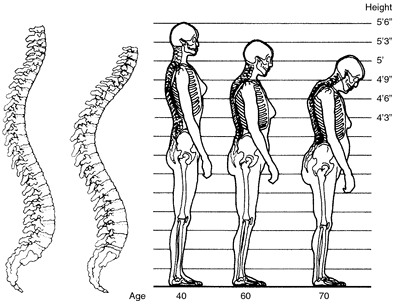
Take a good look at this diagram, wouldn't you rather have the silhouette of the 40 year old at age 70, than the 70 year old at age 50.  Sounds like a silly question but it really is not. There are numerous steps you can take to slow down osteoporotic  degeneration. 

The first step is to get rid of any extra weight you are carrying.   

Osteoporosis is a condition that occurs when the quality and quantity of bone tissue is weakened, making your bones more susceptible to bone loss and breakage. It also prevents your bones from re-modeling and re-building themselves.


The relationship between obesity and osteoporosis has been widely studied.  Initially studies indicated that obesity (increase weight ) may help prevent osteoporosis, but this is not true.  More recent studies have now indicated that the same nutritional problems associated with obesity lead to Osteoporosis. The two conditions are linked. 

Relationship of Obesity with Osteoporosis Lan-Juan Zhao, Yong-Jun Liu, Peng-Yuan Liu, James Hamilton, Robert R. Recker and Hong-Wen Deng - The Journal of Clinical Endocrinology & Metabolism Vol. 92, No. 5 1640-1646

Osteoporosis - Some Important Facts

Osteoporosis should be take seriously, and you should do everything you can to avoid it.  Consider some statistics about osteoporosis. 

  • Over 80% of all fractures in people over fifty years of age are caused by osteoporosis.
  • Osteoporosis causes 70-90% of hip fractures annually.
  • 37% of men and 28% women and who suffer a hip fracture will die within the next year.
  • Only 44% of people, discharged from hospital after a hip fracture, return home.

Osteoarthritis and Obesity

Osteoarthritis is a complex degenerative condition that affects the joints in your body. Primary Osteoarthritis affects the weight-bearing joints in your knees, feet, hips, and lower back, as well as the fingers and neck. 

Osteoarthritis is a condition that is caused by excessive and long-term wear-and-tear of your joints, and is often accompanied by inflammation of the area with pain, swelling, and stiffness.  

Primary Osteoarthritis begins by affecting the cartilage of your joints. Healthy cartilage allows bones to glide over each other and assists in absorbing the shock and stress of movement. In osteoarthritis, the top layer of the cartilage breaks down and wears away, allowing the bones under the cartilage to rub against each other. The rubbing causes inflammation or swelling, pain, and decreased mobility of that joint. Over time, bone spurs may grow and the joint may lose its normal shape.

Obesity increases the chances of developing osteoarthritis since the excess weight multiplies the pressure and forces on the joint, leading to more wear and tear over time.


Osteoarthritis and  Weight Loss -  the GOOD NEWS

Even moderate decreases (15 lbs over 6 weeks) in weight can significantly reduce the amount of pain caused by osteoarthritis. Stephen Messier, a lead author of a noted study showed that "The accumulated reduction in knee load for a 1-pound loss in weight would be more than 4,800 pounds per mile walked".  In other words, for every pound of weight-loss, you will find a four-pound reduction in the stress experienced with each step! 

The effects of even a moderate weight-loss is especially noticeable in weight bearing joints such as the knee and hip. This can result in significant improvement in quality of life. This is an achievable goal, and can help you to live a more pain-free and enjoyable life.


In Part 6 of  "Dr. Abelson's Nutritional Program" we will give some great ideas on what YOU can do to lose the excess weight, and bring your life back into balance.   

Do you want more information about this, and other topics. Our books (eBooks and hard-copy) provide more information about soft-tissue injuries, rehabilitative exercises for injury recovery, and how to use these to activate and restore all the structures of your kinetic chain. 

To purchase our internationally best-selling books, visit www.releaseyourbody.com 


For information about our clinic in Calgary, Alberta, please go to www.kinetichealth.ca.


(COPYRIGHT KINETIC HEALTH 2013 – ALL RIGHTS RESERVED)