Showing posts with label feet bunions. Show all posts

Monday, August 23, 2010

Bunions - Hallus Abductor Valgus – Part 4


Using Exercise to Treat Bunions
Exercise is an essential component in the treatment of bunions, it should not be optional. Soft-tissue therapy without exercise can only achieve a certain level of results, and the probability of the bunion returning becomes very high. Just as the kinetic chain must be considered when determining treatment therapy (ART, Graston, Massage, etc.), the kinetic chain must also be evaluated to identify weak links which can be strengthened through exercises. For example, it has been well established that weak hip muscles are directly related to an increase in abnormal foot pronation, and abnormal pronation has been shown to accelerate the formation of bunions. In such cases, to prevent a reoccurrence of the bunion, you need to do exercises to strengthen and correct the weak hip muscle.

The following are examples of some of the exercises that we prescribe for our patients. (This is not a complete exercise protocol for bunion treatment.) At our clinic, the exercise routines are customized to treat weak links in each patient’s kinetic chain. For more information about specific exercise routines, see www.releaseyourbody.com .

Exercise Examples:
· Strengthening the feet
o Exercise #1: Sit down, with your feet flat on floor, and keeping your heels planted on the ground throughout the exercise. Now raise just your toes off the ground (as far up as you can) while keeping your mid-foot on the ground. Maintain the “toes up” position for 15 seconds with maximum tension, then bring your toes down. Repeat 5 to 10 times.
o Exercise #2: Sit in a chair with your toes on the edge of a towel. Flex and curl your toes to grasp the towel and pull it under your toes. Repeat 5 to 10 times.
· Stretching and mobilizing your foot: Keeping your toes mobile and flexible will help to reduce pain.
o Exercise #1: Sit on a chair, and cross your foot over your knee. Grasp the heel of foot with one hand; grasp your big toe with the other hand. Rotate and stretch your big toe in all directions (do not overstress the joint). At end-range, hold the stretch for 10 to 15 seconds. Repeat this procedure several times in all directions.
o Exercise #2: Stand upright, and wrap an exercise band around both big toes. Move your feet apart until your toes are straightened (keeping the elastic band taut between your feet), then hold this straightened position for several minutes. Repeat several times.
Supportive Aids:
· Orthotics – As mentioned earlier, excessive pronation can be a contributing factor in the formation of bunions. Custom fit orthotics can help stabilize the arch of the foot and reduce or eliminate excessive pronation or supination.
· Taping, bunion pads, toe spacers, and night splints can help to properly position your toes and reduce pain.
In most cases surgery is not necessary for the treatment of bunions. Conservative treatment can be very successful in the treatment of bunions, but you must ensure that your selected practitioner has a good understanding of anatomy, biomechanics, and the various factors causing bunion formation.

If you would like more information or to purchase our books please go to www.releaseyourbody.com . 

If you would like information about our clinic in Calgary Alberta please go to www.kinetichealth.ca.


(COPYRIGHT KINETIC HEALTH 2012 – ALL RIGHTS RESERVED)


1. Brodsky JW, Beischer AD, Robinson AH, et al. Surgery for hallux valgus with proximal crescentic osteotomy causes variable postoperative pressure patterns. Clin Orthop Relat Res. Feb 2006;443:280-6.
2. Frey C, Thompson F, Smith J, et al. American Orthopaedic Foot and Ankle Society women's shoe survey. Foot Ankle. Feb 1993;14(2):78-81. .
3. Hart ES, deAsla RJ, Grottkau BE. Current concepts in the treatment of hallux valgus. Orthop Nurs. Sep-Oct 2008;27(5):274-80; quiz 281-2.
4. Kennedy JG, Collumbier JA. Bunions in dancers. Clin Sports Med. Apr 2008;27(2):321-8.
5. Mann RA, Coughlin MJ. Adult hallux valgus. In: Mann RA, Coughlin MJ, eds. Surgery of the Foot and Ankle. 6th ed. St. Louis, Mo:. Mosby;1993:167-296.
6. Sammarco VJ, Nichols R. Orthotic management for disorders of the hallux. Foot Ankle Clin. Mar 2005;10(1):191-209.

Thursday, August 19, 2010

Bunions - Hallus Abductor Valgus – Part 3


Specific Anatomy: There are four layers of muscle in the foot, with each muscle layer performing a specific action and function. If any of these four areas has been injured, the overall stability of the foot can be compromised, further accelerating the formation of the bunion.
A practitioner who is trained in biomechanics can identify, through gait analysis, just which muscles are creating an abnormal motion pattern. They can then confirm their analysis through hands-on palpation, locate just where the restriction is located, and use soft-tissue treatments to remove those restrictions.
Consider how the following four layers of muscles act to keep your foot aligned.
First Layer of Foot Muscles (Superficial layer)
o Flexor digitorum brevis: Flexes the toe joints (MP & PIP joints).
o Abductor hallucis: Balances out the adductor hallucis. This muscle acts to moves the big toe (hallucis) away from the second toe (abduction), and assists in flexing the big toe.
o Abductor digiti minimi: Moves the little toe away (abduction) from the fourth toe, and assists in flexing the little toe.
Second Layer of Foot Muscles
o Quadratus plantae (QP): This muscle assists with flexion of the four lateral toes. This is an interesting muscle since it attaches to the tendon of the flexor digitorum longus (FDL) which originates under your calf muscles. The tendons of the FDL extend all the way down to insert under your foot at the four lateral toes. A tight FDL affects the function of the QP. This is great example of how the entire kinetic chain must be considered. In this case, a muscle under your calf muscle is affecting the stability of your foot.
o Lumbricals: These muscles help to flex and extend the toes. This set of four muscles has no bony attachment, and attaches from the tendons of the FDL to the tendons of the EDL (extensor digitorum longus). 

Note: The lumbricals are partially controlled by a balance of tension between the FDL and EDL – which act like “guy wires” on the mast of a sailboat. In layman’s terms - the interaction between the muscles of your shins and the deep muscles of your calf directly affect the stability of your foot.
Third Layer of Foot Muscles
o Flexor hallucis brevis: Flexes the big toe at the MTP joint.
o Adductor hallucis: This two headed muscle moves the big toe inward (adduction). This muscle is often overlooked in the treatment of bunions. It is very important to treat this muscle in order to resolve Bunions.
o Flexor digiti minimi brevis: Flexes the little toe at the MTP joint.
Fourth Layer of Muscles
o Dorsal interossei: Four muscles that cause outward motion (abduction) of the third and fourth toes.
o Plantar interossei: Three muscles that cause inward motion (adduction) of the third, fourth and fifth toes at the MP joints.
Remember, a restriction in any one of these muscles will result in an overall decrease in foot stability.
In part four of Bunions – Hallus Abductor Valgus I will provide some specific treatment exercises and discuss the use of supportive aids for the treatment of bunions.

If you would like more information or to purchase our books please go to www.releaseyourbody.com . 

If you would like information about our clinic in Calgary Alberta please go to www.kinetichealth.ca.


(COPYRIGHT KINETIC HEALTH 2012 – ALL RIGHTS RESERVED)


Bunions - Hallus Abductor Valgus – Part 2


Symptoms
In the first stages of bunion formation, bunions are often not painful until there is a significant inward deviation of the big toe. Some of the symptoms commonly associated with bunions include localized pain near the joint (often only with palpation), redness, swelling and restricted motion.
Diagnosis
In addition to a complete physical examination and history, X-rays are often taken. X-rays enable the physician to measure joint angles in order to determine the severity of the condition. It also allows the physician to rule out fractures or other pathological processes.
Treatment
Treatment can be divided into non-surgical (conservative) and surgical treatments.
Surgical Treatment: Surgery is sometimes necessary when the pain from a bunion is extremely severe, or when a bunion has grown past certain limits. The success rate for bunion surgery is very high, especially when measured in terms of performing your ADL’s (activities of daily living) and pain reduction. Complications from surgery include: infections, nerve damage, scar tissue formation, over or under-correction, and blood clots. It is also import to note that the bunion can reoccur if the underlying factors that caused the initial bunion formation are not properly dealt with. The surgery it self may alter the pressure pattern on the bottom of the foot (alignment), causing certain biomechanical imbalances.
Please Note: Something to keep in mind for professional dancers; a bunion surgery will often be the end of that dancer’s career. This is because most dancer cannot return to their pre-operative state.
Conservative Treatment: The objective of conservative treatment is to prevent the progression of the bunion by correcting the biomechanical stress on the foot, realigning the joint as much as possible, and increasing the intrinsic strength of the foot.
Fortunately, in most cases surgery is not necessary, and conservative treatment can be very successful, especially when the following factors are addressed:
· Shoes: Sorry - but those high heels will have to go (except on the rarest of occasion) - especially when the bunion is extremely painful. The best shoes for bunions are flat shoes with a wide toe box. If you wear shoes that rub against your bunion it will only get larger. Some of the best choices are: wide athletic shoes, crocs, and sandals. The only problem with sandals is that you will not be able to wear orthotics within them to correct excessive pronation (if over-pronation is part of the problem). You can also try a shoe stretcher to increase the space in your current shoes.
· Soft Tissue Restrictions: It is essential to remove soft tissue restrictions in order to bring the big toe back into its neutral position. Without addressing these restrictions, the bunion will continue to expand. There are various techniques that can be used to break up these restrictions such as Active Release Techniques, Graston Techniques, Massage Therapy, or various types of fascial manipulation. The exact area of restriction will vary for each individual case. Using a golf ball on the bottom of your foot and performing self-massage can also be of great benefit.
· Foot Stability: Besides the obvious restrictions that may be found in the Adductor Hallucis, we also have to consider the other muscles that are involved in stabilizing the entire foot. Think of your foot the same way you would think of your car. Your car has four tires, each of which must be kept in alignment. If one of your tires is out-of-alignment, it affects the motion of the entire vehicle. The same thing occurs with the muscles of your feet. It only takes a restriction in one muscle to affect the stability of the entire foot
In part three of Bunions – Hallus Abductor Valgus, I will cover the specific anatomy involved in bunion formation, from the perspective of overall foot stability and identify which structures may need to be treated.

If you would like more information or to purchase our books please go to www.releaseyourbody.com . 

If you would like information about our clinic in Calgary Alberta please go to www.kinetichealth.ca.


(COPYRIGHT KINETIC HEALTH 2012 – ALL RIGHTS RESERVED)


Bunions - Hallus Abductor Valgus – Part 1


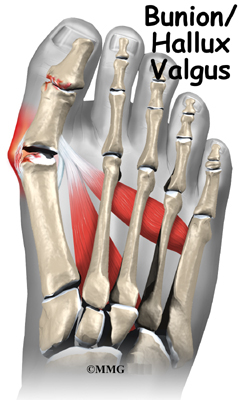
Bunions (Hallus Abducto Valgus) are a common foot problem that affects the joint at the base of the big toe (first metatarsophalangeal joint). In Latin “bunion” means enlargement, while “hallux abducto valgus (HAV)” refers to a bending inwards of the big toe as seen on the image.

As you see, the big toe bends in towards the other toes while the bone behind it (1st metatarsal) pushes outward. This creates a considerable amount of stress on the joint (first metatarsophalangeal joint). Due to this bending inwards, a sharp angle at the big toe joint is created, resulting in the formation of a bunion. Initially, this enlargement is composed of swollen tissue which becomes irritated by any external pressure (for example tight shoes). Eventually this swollen tissue thickens to form a very large lump or bunion.
There is an obvious relationship between bunions and shoes, since bunions do not occur in cultures that go barefoot. High heels, pointed shoes, ballet shoes, excessively tight shoes, and even cowboy boots often lead to the development of bunions.
Anatomy and Biomechanics
From a biomechanical perspective, bunion formation creates a cycle of dysfunction. As the bone behind the big toe (1st metatarsal bone) moves outwards, the inner arch of the foot becomes unstable and starts to collapse. This instability, or lack of support in the arch, increases stress on the angle at the point where the bunion is forming. This stress accelerates the formation of the bunion, which in turn further destabilizes the arch of the foot. To truly deal with this problem, you must address both the foot instability and joint angle.
In addition to the stresses caused by poor shoes, simply walking with your feet in a turned out position can also lead to bunion formation from the stress it puts on two particular muscles. This “turned out” position leads to an imbalance between two muscles - the adductor hallicus and the abductor hallicus.
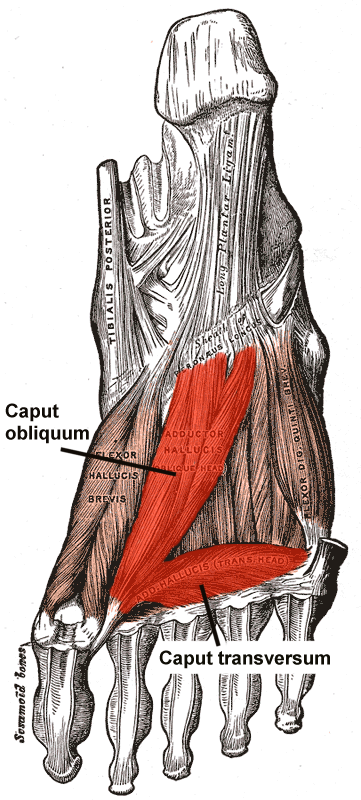
The adductor hallicus is an interesting muscle which is shaped like the number seven. The adductor hallicus transverses from several of the lateral toes into your big toe. When the adductor hallicus contracts, it pulls the big toe towards the 2nd toe.
· For those of you who have been asking for a more technical anatomical description…well here you go! The adductor hallicus has two heads - the oblique and lateral head. The oblique head originates in the 2nd, 3rd, and 4th metatarsals. The tranverse head originates from the 3rd, 4th, and 5th toes (metatarsophalangeal ligaments). Both heads insert into the big toe (lateral sesamoid bone at the MP joint, and into the proximal phalanx of the big toe).
When the adductor hallicus muscle becomes tight and restricted, it continually pulls the big toe towards the second toe (even without contracting). The adductor hallicus tends to become restricted in individuals who excessively pronate or walk with their feet turned outwards (a huge percentage of runners and dancers).
This pulling action of the adductor hallicus disrupts a key balance in muscle tension, which normally keeps the big toe in a neutral or straight position. This balance occurs between the adductor hallicus and the abductor hallicus muscles.
The abductor hallucis normally resists the pulling action of the adductor hallicus. The abductor hallucis runs from your heel (calcaneus) to your big toe (proximal phalanx). Constant pulling from the adductor hallicus weakens and overstretches the abductor hallucis. Without the appropriate counter-balancing action of the abductor hallucis, the big toe moves inward, and bunion formation accelerates.
In part two of Bunions – Hallus Abductor Valgus, I will disuss: Symptoms, Diagnosis, some Treatment possibilities.

If you would like more information or to purchase our books please go to www.releaseyourbody.com . 

If you would like information about our clinic in Calgary Alberta please go to www.kinetichealth.ca.


(COPYRIGHT KINETIC HEALTH 2012 – ALL RIGHTS RESERVED)