Showing posts with label Dr. Brian Abelson. Show all posts

Wednesday, February 20, 2013

Dr. Abelson's – Essential Nutritional Program Part 6


Fat loss 101

Think long-term…. avoid the rebound effect!

Keep your weight-loss goals realistic. It is reasonable to expect to lose about one to three pounds per week. Too rapid weight-loss almost always results in a rebound effect, where all the lost weight returns if you fall off the path. In many weight-loss programs, the quick weight that you lose is often due to loss of muscle, rather than fat loss. When you lose muscle mass, you actually lower your metabolism since muscles are the primary “burners” of carbohydrates and fats in your body.


Dramatic decreases in caloric intake leads to decreased or slower metabolism, and more weight gain.


Suddenly reduced, or too low, caloric intake leads to a loss of muscle mass as your body struggles to meet its daily energy requirements by burning muscle rather than fat. It also causes your body to STORE FAT. This can happen whenever you eat less than 1000 calories a day. Your body requires at least 1500 calories a day just to perform its basic functions. Decreases in your muscle mass results in a decrease in your metabolic rate, which in turn results in more fat being stored! This is the major reason for the failure of over 80% of all diet plans. Instead of training your body to burn fat, they train your body to store fat.


Graze, Don’t Gorge!


Frequent SMALL meals are better for weight loss. Frequent small meals serve to convince your body that you are NOT starving, that food is abundant, and that fats DON’T need to be stored for hard times. Basically, you need to provide you body with good quality food on a regular basis. This will have several positive effects:  it will help balance your blood sugar, accelerate  healing, and provide you with  the energy you need for exercising.  


Your Mother was right…. you need to eat breakfast!


Did you know that your body burns about 450 calories when you sleep at night? Your body needs to re-fuel at breakfast time. If you don’t have breakfast, your blood sugar levels can fall too low, resulting in cravings for high-sugar food. Successful individuals in any weight-loss program always eat breakfast. 


Forget the fast food.


Fast food is generally made with cheaper ingredients, such as high fat meat, lots of saturated and trans fats, lots of salt, and cholesterol. All of these ingredients lead to health problems, weight gain, high blood pressure, inflammation, and heart disease. Consider what is in a basic, medium-size,  fast food meal of a burger, French Fries, and a vanilla shake. In that one meal you will get 87 grams of fat and 1,480 calories. If you want to gain weight, inflame your body, and die of a heart attack, then by all means, go for it and enjoy that meal.


Start thinking about your body-fat percentage not your weight. 


Body-fat percentage measures the percentage of fat in your body. If you are 200 pounds and 30% fat, it means that your body consists of 60 pounds of fat and 140 pounds lean body mass. Your goal is to gain muscle (which burns fat). Remember, muscle also weighs more than fat. So initially, don’t worry about what the scales say. Your focus is to get rid of the fat while adding on muscle.


Add Muscle to Your Body


Muscles burn more calories than any other type of tissue in your body (with the exception of your brain). Muscles help to increase your resting metabolic rate, which means you burn fat even when resting. For each pound of muscle that you add to your body, you will burn an extra 50 calories each day. This means if you add five pounds of muscle mass to your body, you can burn 250 extra calories a day, even when you are just sitting around.

Strength training (or muscle building) should be one of the fundamentals of any weight loss program. (Note: diet changes alone will not give you the results you want!) Strength training builds muscle mass and increases your resting metabolic rate. Exercise and strength training are the keys for getting rid of all that already stored, excess fat.

It is important to differentiate between weight-lifting exercise and cardiovascular exercise. There is no doubt, that cardiovascular exercise does burn a lot of calories. The problem is, it is not nearly as efficient at turning up your fat burning furnace as weight lifting can be.  In fact when you compare the two exercise formats,  cardiovascular exercise is about 40% less efficient at burning fat than weight lifting . I am not saying you should give up your cardio-routine.  Cardiovascular exercise is great for your overall health, especially your heart. The problem is that using only cardio as your primary exercise will not help you to achieve the fat loss you what.

I am currently developing an weight-loss exercise routine that is designed to help you increase muscle mass (lose fat). I will be presenting this in a future blog. 


Get a good night’s sleep!


You need to sleep at least 8 hours every night if you want to lose weight. Lack of sleep increases stress, stress increases cortisol levels in your body, and  increased cortisol levels result in weight gain. Lack of sleep affects the level of hormones which control weight-loss – melatonin and human growth hormone. Both of these are produced during sleep, and interruptions and lack of production inhibits their positive effects on your body. In fact, research has shown that the probability of your being obese is 73% higher if you get only four hours of sleep per night.

Specific Dietary Recommendations


If you want to lose fat, decrease your body fat percentage, and feel the best you have felt for years here is what I suggest.

Stay hydrated: 

Drink two glasses of water before each meal.  Then continue to drink water on a regular basis throughout the day. Read my blog about the importance of hydration for more information.

Drinking lemon or lime water is a great way to make your body more alkaline.  The amazing thing is that lemons can turn even regular tap water alkaline. 


Meals and snacks:


My basic dietary program is quite simple, eat three meals per day and 2 or 3 snacks.  Avoid processed or packaged foods, refined carbohydrates, high fat foods, and eat your foods in as natural a state as possible. You should also do everything can to make your food taste great. Use spices and herbs liberally but take it easy on the salt you add to your food.

Each meal should contain protein, complex carbohydrates and essential fatty acids.  You should also try to make choices that will make you meals more alkaline in nature (See PRAL list for more information).

Please note:  The links I have included to recipes in this section do contain some great ideas.  This being said, all recipes will not be appropriate for all individuals.  Please consider what each recipe contains, especially if you are allergic to certain foods. Remember,eating health foods can be a very enjoyable experience.  You can lose all the fat you want, and still enjoy your food.

Breakfast


First off you need to eat breakfast, "DO NOT SKIP THIS MEAL" Breakfast should contain a serving of protein, dairy, fruit or grains and any amount of vegetables you would like.

You can have coffee (espresso is more pH balanced - drip coffee is quite acidic), tea (ginger or green tea), or "FRESH" vegetable or fruit juice with your breakfast. Benefits of fresh juice is a blog on its own, please follow this link if you would like to learn some of its benefits.


Please note: If you are having grains, then make sure you are not reacting to wheat or gluten. Again a topic for a future blog. In the meantime,  if you would like to read an interesting article, here is a link to an interview of Dr. William Davis, the author of "Wheat Belly".

I hope you enjoy some of these breakfast recipes 

Breakfast Recipe Suggestions:


Lunch

At lunch, you should have a serving of protein, fruit, and any amount of vegetable that you would like.  Remember to drink two glasses of water (lemon water preferably) before you eat your lunch.


Lunch Recipe Suggestions:


Dinner


Again, as with the other two meals, you need to get a serving of protein, complex carbohydrates and essential fatty acids.

For many individuals this is the main meal of the day.  Try not to bulk up on this meal, and be sure to spread your total food  intake throughout the day. As with the other meals, take a look at the PRAL chart to balance out the acidity of the meal. 


Dinner Recipe Suggestions:

Snacks:


There are numerous healthy foods that you can use as snack throughout the day.  Just be sure not to eat too much of these foods, otherwise you may find that you are sabotaging your fat-loss program.  


Healthy Snack Suggestions:


I hope you will consider following the fat loss program I have just laid out for you.  This program can literally transform your life.  It has taken many of my patients out of pain, returned their energy, and literally revitalized their lives.  I hope it can do the same for you. 


Do you want more information about this, and other topics. Our books (eBooks and hard-copy) provide more information about soft-tissue injuries, rehabilitative exercises for injury recovery, and how to use these to activate and restore all the structures of your kinetic chain. 

To purchase our internationally best-selling books, visit www.releaseyourbody.com.  


For information about our clinic in Calgary, Alberta, please go to www.kinetichealth.ca. Or call us at 403-241-3772.


(COPYRIGHT KINETIC HEALTH 2013 – ALL RIGHTS RESERVED)


Sunday, April 29, 2012

Improving Performance with Total Immersion Technique


I Just finished the 8-week beginner program for Total Immersion Swimming with Coach Grant (Grant Molyneux) at the Vecova Pool in Calgary. I must say, I am really impressed with this program.  I read the book about Total Immersion several years ago but did not get a chance to take the program until now.  Now, I have already signed up for the intermediate level.

Even when I first read the book about total immersion, I found the concept to be very logical. Basically, it is based on the idea of swimming deeper in the water to reduce resistance, while at the same time streamlining the motions of the body. Just as a submarine can move faster under the water, than up on the surface, so also can the human body. The overall concept sounds simple, but it soon became obvious to me that the implementation of this concept would take some retraining.

Total immersion is like doing Tai Chi in the water; the concepts and ideas are remarkably similar. With Tai Chi, you learn how to move without resistance, how to breathe naturally, and how to reduce the overall energy expenditure of each motion. Total Immersion is exactly the same, except it is performed in the water.

The lessons

It may sound strange, but we spent the first 8 weeks learning drills that taught us how to just balance in the water, how to float, and get started on the path of moving in water without resistance. It literally took us unitl the end of the course before we were allowed to swim one length of the pool properly. It wasn't until the 2nd last lesson that we started to introduce breathing into our strokes. This may sound like very slow progress, but it was not. We were breaking all the bad habits that have been accumulated over the years. I have been doing triathlons for over 30 years, swimming with master swim clubs, and have taken numerous stroke improvement courses; yet in 8 weeks, I learned more about the importance of balance and body position than in all those other courses combined.

The Total Immersion program does this by starting out with some very effective drills such as:

Superman Glide (Click for Video)

The Superman Glide is a great drill that teaches you how to streamline your body and move through the water without resistance.  It teaches you about body alignment and balance, andshows you how the water will support you, if you are in the right position. In a sense, it is the first exercise that makes you consciously aware of head, shoulder, arm, hand, torso, leg, and foot position.  Click to view this video to see just how deep in the water the swimmers head position should be.

Skating Drill (Click for Video)

The Skating Drill enables you to reduce the drag on your body by learning how to lengthen your bodyline. When you watch this video see how the swimmer starts out in the Superman Glide and then goes onto her side into the Skating Position. This Skating Position is incredibly hydrodynamic. This position will literally make you travel faster and farther with each stroke you take. This position is one of the reasons why efficient TI swimmers can reduce by 50% the number of strokes they take to swim a length.

These are just a couple of the drills that we learned, but they serve to demonstrate the type of training we experienced in the beginner section of this program.  It's really important not to underestimate the importance of these drills, as even at my beginner stage of this program, I have seen remarkable changes in my own swimming efficiency.

In Conclusion

Bottom line, I highly recommend taking a course in Total Immersion Swimming.
  1. Triathlons: If you are doing triathlons, the course will not only improve your speed, but will reduce your energy expenditure so that you have more energy for the bike and the run. Anyone, like myself, who has ever done Ironman length races, knows that every last bit of energy is pure gold by the end of the run.
  1. Life Skill: Total Immersion Swimming is a great benefit for anyone. It is is an exercise that you can perform at any age. It is a no impact exercise. But the most important reasons is stress reduction.  We live in a very stress-driven society, and stress is a major contributing factor in just about any illness or injury. Learning a skill such as TI would greatly help you to reduce the impact of these stresses.
Since taking the Beginner TI course at the Vecova Pool in Calgary I have started to recommend this program to many of my patients. I cannot say a big enough Thank You to Coach Grant; not only have you introduced me to a great program, but you have given me a great option which I can recommend to many of my patients.

All the best in health, Dr. Brian Abelson DC.


If you would like more information or to purchase our books please go to www.releaseyourbody.com . 

If you would like information about our clinic in Calgary Alberta please go to www.kinetichealth.ca.


(COPYRIGHT KINETIC HEALTH 2012 – ALL RIGHTS RESERVED)

Monday, March 5, 2012

Disc Injuries - Most Do Not Require Surgery


Spinal Disc Degeneration

Disc degeneration is part of the normal aging process. As we age, our discs begin to shrink due to loss of fluid within the discs. This loss of fluid in the disc leads to a decrease in the normal height of the disc, thereby decreasing the disc’s ability to absorb shock.

The lack of shock absorption by the discs causes increased stress on the facet joints (a gliding joint between each vertebra) of the spine and results in facet joint degeneration.

These changes may eventually cause increased pressure on the nerve roots (nerves that exit from the spinal cord) and may result in sciatic-type pain down the arm or leg). This condition is often referred to as Degenerative Disc Disease.

Disc Herniation, Protrusion, Prolapse, & Extrusion

A disc protrusion (also known as a disc bulge) occurs when the inner material of the disc starts to push out through the outer wall of the disc, creating a bulge in the disc. In most cases this disc bulge is completely symptomless, and causes no pain or lack of function. In fact, most individuals over the age of forty have disc bulges.

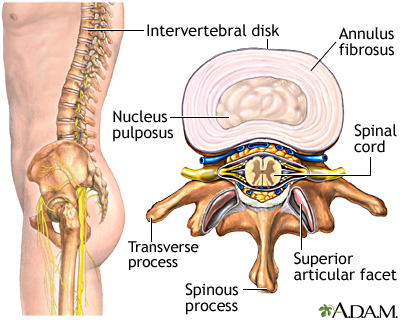
Problems occur when these disc protrusions start to fragment or tear. A herniated disc occurs when the inner material of the disc (the nucleus pulposus) starts to push through the outer fibres of the disc (the annulus fibrosus). Most disc herniations occur at the lower levels of the spinal column.

When the outer layers of a disc rupture, the inner centre of the disc may move out and press upon a nerve. This condition is known as disc prolapse or protruding disc. In such cases, the material inside the disc can sometimes extrude into the vertebral (spinal) canal.

In rare cases a severe prolapse will press on the nerves which control bowel and bladder function, resulting in severe muscle atrophy. These are rare events and are considered to be surgical emergencies. The majority of disc prolapses do not fit into this category. In yet other cases, a disc may extrude right through the outer fibres of the disc, and a piece may break off completely.

When this occurs, the extruded piece of disc can interfere with the function of the nearby nerves. This condition – sequestered disc – requires surgical intervention if it is causing neurological dysfunction; it is a problem that cannot be resolved with manual therapy.

However, the most important point to be made is that most cases that involve a disc bulge or protrusion do not require surgery. In fact there are a couple of common myths about disc protrusions that we should consider:
  • The first myth is that the presence of a large disc protrusion – often seen on MRI or CAT scan images – is an indication that this problem cannot be resolved with conservative care (non- surgical). In reality, research is showing the exact opposite to be true. The larger the disc protrusion, the greater the reduction in protrusion size after conservative treatment.
  • The second myth is that the extruded and sequestered disc fragments are less likely to resolve than the contained protrusions. In actuality, the migrating fragments actually resolve more frequently and faster than the contained protrusions.  The reason for this; the larger the disc protrusion, the greater the degree of inflammation around the protrusion. Once the disc fragments have broken off and inflammation has decreased around the fragments and disc decreases, the body is able to reabsorb the fragments easily. 

Treating and Resolving Disc Injuries

Initially, disc injuries can feel incredibly painful, and it may seem that surgery is the inevitable outcome. Fortunately, the majority (95%) of patients suffering from disc injuries do NOT need surgery. However, you will need to be patient as you work through the resolution process.

The actual time required to resolve a disc injury varies based on the severity of the injury, length of time the problem has existed, your age, and your current and historical physical condition. To effectively resolve a disc injury, it is necessary to:
  • Remove any type of mechanical restriction that is causing stress upon the disc.
  • Avoid all physical stresses that are perpetuating that problem. Anything that can be done to remove biomechanical stress from the back can benefit the patient. This includes:
Icing and Anti-inflammatories during the Acute Stage:

During the acute stage of the injury, anti-inflammatories and ice are useful, but only provide relief at a symptomatic level. During the initial stage of injury:

  • Perform ice massage on the affected area for at least the first 72 hours to reduce pain, inflammation, swelling, and muscle spasms.
  • Rest for a maximum of two days during the acute stage of the injury. In fact, you may find that resting is about as much as you can manage!
  • Return to as many of your normal, daily living activities as you can manage after the first 48 to 72 hours. This will increase the speed of your recovery. 
Performing the Activities of Daily Living: 

With a disc injury, you will have to find a way to perform your daily living activities without aggravating your condition or increasing the resulting pain. This may mean that you must:
  • Reduce your range of motion as you perform each task.
  • Move more through your hips rather than through your back.
  • Brace your core before lifting or moving any object 
  • Avoid repetitive actions that are performed in a flexed or bent- over spinal position since this can result in increased disc damage. This is especially true if you are lifting heavy loads from this position.
  • Take frequent rest breaks. If you have a sedentary job (sitting at a desk), then take active breaks to walk around, and move all your limbs. If you have an active job, then slow down, sit, and relax for a few minutes.
  • Listen to your body. If it says that a task is beyond your current capability, then stop before you cause further injuries which can change an acute problem into a chronic problem.
Using Soft Tissue Therapy and Spinal Manipulation

Any injured muscle, joint capsule, ligament, tendon, fascia, or connective tissue restriction can cause changes in motor patterns (neuromuscular imbalances) which then directly affect spinal stability. The specific physical restrictions that need to be addressed in a disc injury will vary depending on the individual. However, the removal of any type of mechanical restriction is of great benefit for any type of disc injury. The practitioner will need to palpate the affected areas and conduct appropriate biomechanical analysis in order to determine exactly which areas need to be addressed.

Imbalances in muscular tension increase stress on the spinal discs, which then perpetuates or causes further injury. Fortunately, those spinal imbalances can be addressed with manual procedures.

Good results are obtained when these procedures are combined with dynamic exercises that re-establish normal motor control.

For example, soft tissue therapies (ART, Graston, Registered Massage Therapy, Fascial Manipulation) can be used to release restricted structures around the discs, such as:

  • Multifidus Muscles (Deep posterior extensors and stabilizers of the spine.) Research has shown that a disc injury can reduce neurological input to the multifidus muscle. This reduction in neurological input can lead to muscle wasting of the Type 1 and Type 2 fibres. ART procedures are able to help restore normal multifidus function.
  • Abdominal Muscles and Extensors of the Back - An imbalance between the abdominal muscles and extensors of the back can affect muscle strength, lumbar lordosis (curvature of the lumbar spine), sacral angle, and spinal stability. Any imbalances between these antagonistic structures causes increased spinal tension and spinal instability, and places stress on the disc. ART protocols in combination with the proper exercises are very effective at resolving these imbalances.


If you would like more information or to purchase our books please go towww.releaseyourbody.com . 

If you would like information about our clinic in Calgary Alberta please go to www.kinetichealth.ca.


(COPYRIGHT KINETIC HEALTH 2012 – ALL RIGHTS RESERVED)

Tuesday, February 14, 2012

How Abnormal Motion Patterns Cause Shoulder Injuries


Many shoulder problems are caused by abnormal motion patterns that occur as the body attempts to continue performing daily living activities while compensating for the effects of previous injuries. Some of the most common abnormal motion patterns that we see are caused by:
  • Shoulder Joint Instability
  • Abnormal Movements of the Shoulder Blade
  • Restrictions in Internal Shoulder Rotation
Shoulder Joint Instability
Research has shown that extended periods of shoulder instability (glenohumeral instability) can start a cycle of micro-trauma and secondary impingement syndromes which often result in chronic shoulder pain. Practitioners will often find this type of instability during shoulder examinations and translation tests.
Anterior shoulder instability (laxity of the anterior capsule) is often related to problems in the posterior shoulder capsule. This combination of problems can have a considerable impact upon the structures of the shoulder’s kinetic chain
When the posterior shoulder capsule becomes tight, it affects the IGHL (inferior glenohumeral ligament). This ligament helps to maintain your shoulder’s position in the joint and acts as a supporting hammock or sling for the humeral head. When your IGHL does not function the way it should, your arm (humeral head) changes position, which can then result in a variety of impingement syndromes.
Abnormal Movements of the Shoulder Blade
Numerous studies have shown that abnormal motion patterns of the shoulder blade (Scapular Dyskinesis) can result in a variety of shoulder impingement syndromes. These alterations in muscle activity are often overlooked by clinicians when reviewing patients who have been diagnosed with a rotator cuff injury.
Abnormal shoulder blade motion typically causes an alteration in the muscle firing patterns of the:
These abnormal motion patterns affect the patient’s ability to bring their shoulder forward or backward (protraction and retraction). A lack of backward motion (retraction) often leads to hyperangulation - a risk factor that can lead to shoulder impingements.
I believe that it is extremely important to restore normal motion patterns for the shoulder blade, since the presence of abnormal motion patterns substantially increases the probability of an injury reoccurring.
A practitioner who tests for and discovers alterations in normal shoulder motion can apply the appropriate Soft Tissue procedures and exercises to solve this problem.
Restrictions in Internal Shoulder Rotation
An increased risk of shoulder impingements is often associated with restricted internal rotation of the shoulder. This is especially true when an action requires the shoulder to be both flexed and internally rotated.
In this position, increased pressure is experienced between the insertion of the supraspinatus muscle and the acromion or coracoacromial ligament. This area often becomes the focal point of an impingement. For example:
  • The supraspinatus muscle is a rotator cuff muscle that raises the arm to your side.
  • The acromion is a part of the shoulder blade (scapula) that lies above the shoulder joint. The acromion articulates with the clavicle to form the acromioclavicular joint which is a common restriction point.
  • The coracoacromial ligament is a strong triangular band on the shoulder blade, which with the coracoid process and the acromion, forms a vault for the protection of the head of the humerus.
Consequently, in cases where restrictions in internal rotation are noted (common with rotator cuff injuries), the practitioner should always look for and address impingements at these important focal points.

If you would like more information or to purchase our books please go to www.releaseyourbody.com . 

If you would like information about our clinic in Calgary Alberta please go to www.kinetichealth.ca.


(COPYRIGHT KINETIC HEALTH 2012 – ALL RIGHTS RESERVED)