Showing posts with label disc injury. Show all posts

Monday, March 5, 2012

Disc Injuries - Most Do Not Require Surgery


Spinal Disc Degeneration

Disc degeneration is part of the normal aging process. As we age, our discs begin to shrink due to loss of fluid within the discs. This loss of fluid in the disc leads to a decrease in the normal height of the disc, thereby decreasing the disc’s ability to absorb shock.

The lack of shock absorption by the discs causes increased stress on the facet joints (a gliding joint between each vertebra) of the spine and results in facet joint degeneration.

These changes may eventually cause increased pressure on the nerve roots (nerves that exit from the spinal cord) and may result in sciatic-type pain down the arm or leg). This condition is often referred to as Degenerative Disc Disease.

Disc Herniation, Protrusion, Prolapse, & Extrusion

A disc protrusion (also known as a disc bulge) occurs when the inner material of the disc starts to push out through the outer wall of the disc, creating a bulge in the disc. In most cases this disc bulge is completely symptomless, and causes no pain or lack of function. In fact, most individuals over the age of forty have disc bulges.

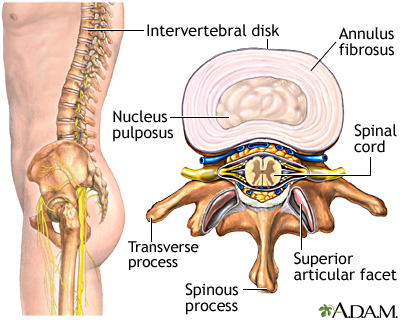
Problems occur when these disc protrusions start to fragment or tear. A herniated disc occurs when the inner material of the disc (the nucleus pulposus) starts to push through the outer fibres of the disc (the annulus fibrosus). Most disc herniations occur at the lower levels of the spinal column.

When the outer layers of a disc rupture, the inner centre of the disc may move out and press upon a nerve. This condition is known as disc prolapse or protruding disc. In such cases, the material inside the disc can sometimes extrude into the vertebral (spinal) canal.

In rare cases a severe prolapse will press on the nerves which control bowel and bladder function, resulting in severe muscle atrophy. These are rare events and are considered to be surgical emergencies. The majority of disc prolapses do not fit into this category. In yet other cases, a disc may extrude right through the outer fibres of the disc, and a piece may break off completely.

When this occurs, the extruded piece of disc can interfere with the function of the nearby nerves. This condition – sequestered disc – requires surgical intervention if it is causing neurological dysfunction; it is a problem that cannot be resolved with manual therapy.

However, the most important point to be made is that most cases that involve a disc bulge or protrusion do not require surgery. In fact there are a couple of common myths about disc protrusions that we should consider:
  • The first myth is that the presence of a large disc protrusion – often seen on MRI or CAT scan images – is an indication that this problem cannot be resolved with conservative care (non- surgical). In reality, research is showing the exact opposite to be true. The larger the disc protrusion, the greater the reduction in protrusion size after conservative treatment.
  • The second myth is that the extruded and sequestered disc fragments are less likely to resolve than the contained protrusions. In actuality, the migrating fragments actually resolve more frequently and faster than the contained protrusions.  The reason for this; the larger the disc protrusion, the greater the degree of inflammation around the protrusion. Once the disc fragments have broken off and inflammation has decreased around the fragments and disc decreases, the body is able to reabsorb the fragments easily. 

Treating and Resolving Disc Injuries

Initially, disc injuries can feel incredibly painful, and it may seem that surgery is the inevitable outcome. Fortunately, the majority (95%) of patients suffering from disc injuries do NOT need surgery. However, you will need to be patient as you work through the resolution process.

The actual time required to resolve a disc injury varies based on the severity of the injury, length of time the problem has existed, your age, and your current and historical physical condition. To effectively resolve a disc injury, it is necessary to:
  • Remove any type of mechanical restriction that is causing stress upon the disc.
  • Avoid all physical stresses that are perpetuating that problem. Anything that can be done to remove biomechanical stress from the back can benefit the patient. This includes:
Icing and Anti-inflammatories during the Acute Stage:

During the acute stage of the injury, anti-inflammatories and ice are useful, but only provide relief at a symptomatic level. During the initial stage of injury:

  • Perform ice massage on the affected area for at least the first 72 hours to reduce pain, inflammation, swelling, and muscle spasms.
  • Rest for a maximum of two days during the acute stage of the injury. In fact, you may find that resting is about as much as you can manage!
  • Return to as many of your normal, daily living activities as you can manage after the first 48 to 72 hours. This will increase the speed of your recovery. 
Performing the Activities of Daily Living: 

With a disc injury, you will have to find a way to perform your daily living activities without aggravating your condition or increasing the resulting pain. This may mean that you must:
  • Reduce your range of motion as you perform each task.
  • Move more through your hips rather than through your back.
  • Brace your core before lifting or moving any object 
  • Avoid repetitive actions that are performed in a flexed or bent- over spinal position since this can result in increased disc damage. This is especially true if you are lifting heavy loads from this position.
  • Take frequent rest breaks. If you have a sedentary job (sitting at a desk), then take active breaks to walk around, and move all your limbs. If you have an active job, then slow down, sit, and relax for a few minutes.
  • Listen to your body. If it says that a task is beyond your current capability, then stop before you cause further injuries which can change an acute problem into a chronic problem.
Using Soft Tissue Therapy and Spinal Manipulation

Any injured muscle, joint capsule, ligament, tendon, fascia, or connective tissue restriction can cause changes in motor patterns (neuromuscular imbalances) which then directly affect spinal stability. The specific physical restrictions that need to be addressed in a disc injury will vary depending on the individual. However, the removal of any type of mechanical restriction is of great benefit for any type of disc injury. The practitioner will need to palpate the affected areas and conduct appropriate biomechanical analysis in order to determine exactly which areas need to be addressed.

Imbalances in muscular tension increase stress on the spinal discs, which then perpetuates or causes further injury. Fortunately, those spinal imbalances can be addressed with manual procedures.

Good results are obtained when these procedures are combined with dynamic exercises that re-establish normal motor control.

For example, soft tissue therapies (ART, Graston, Registered Massage Therapy, Fascial Manipulation) can be used to release restricted structures around the discs, such as:

  • Multifidus Muscles (Deep posterior extensors and stabilizers of the spine.) Research has shown that a disc injury can reduce neurological input to the multifidus muscle. This reduction in neurological input can lead to muscle wasting of the Type 1 and Type 2 fibres. ART procedures are able to help restore normal multifidus function.
  • Abdominal Muscles and Extensors of the Back - An imbalance between the abdominal muscles and extensors of the back can affect muscle strength, lumbar lordosis (curvature of the lumbar spine), sacral angle, and spinal stability. Any imbalances between these antagonistic structures causes increased spinal tension and spinal instability, and places stress on the disc. ART protocols in combination with the proper exercises are very effective at resolving these imbalances.


If you would like more information or to purchase our books please go towww.releaseyourbody.com . 

If you would like information about our clinic in Calgary Alberta please go to www.kinetichealth.ca.


(COPYRIGHT KINETIC HEALTH 2012 – ALL RIGHTS RESERVED)

Thursday, June 24, 2010

Treating Disc Injuries With Manual Therapy and Exercise – Part 3


Prescribing the right type of exercises for a disc problem is essential. The first thing when it comes to exercising with a disc injury is to avoid exercises that cause more injury. It may sound strange but most disc patients, back patients are prescribed exercises that perpetuate their conditions.

If we consider the mechanism of how disc injuries occur we can obtain considerable insight into what exercises to perform and which to avoid. Considering that cumulative motions with your spine in a flexed position commonly lead to disc tears, exercises such as bent-knee sit-ups should definitely be avoided.

One of our main objectives in prescribing exercises to disc patients should be to increase neuromuscular control and muscular endurance. Just focusing on increasing strength and flexibility often leads to poor results.

On a general note, the spinal exercises (other than a Cat Camel stretch) should not be performed first thing in the morning. You need to give your body time to warm up; the discs and surrounding soft-tissue structures of your spine are very stiff. This is partially due to an increase of viscosity in the disc. When you lie down at night your discs rehydrate all the fluid that was pushed out with the compressive force of gravity – you standing.

This increased viscosity in your discs can create increased internal friction which can have a very damaging affect on disc problems. That is why we recommend Cat Camel stretches first thing in the morning. This exercise pumps fluid out of the disc, reducing the chance of injury first thing in the morning.

Important Principles:
No Pain All Gain
  • Exercising in a manner that causes pain develops abnormal neuromuscular patterns that may lead to further injury. Conventional rehabilitation strategies commonly do not succeed because they do not address the underlying neuromuscular problems. They are often designed to make you work through your pain (as in work- hardening programs). This only causes you to create or reinforce the abnormal motor responses which in turn continues to keep you in pain.
  • In addition, if you work through pain caused by tissue damage you run the risk of central sensitization. This is a nervous system process which causes you to become more sensitive to pain. The only way to break this pattern is to perform your exercises in a pain-free zone.
  • We commonly have patients come to our clinic who have exercised through their pain for years! They are always amazed at how, by exercising within a pain-free zone, we were able to help them break their pain- cycle in just a few short weeks.
Cardiovascular exercise is important

  • Besides stretching and strengthening exercises rehabilitative care of any injury requires you to build a good aerobic base. Your cardiovascular system is responsible for transporting oxygen and nutrients to all your cells, and for carrying away toxins and waste products.
  • Building up your aerobic base makes you heal faster by increasing the density of capillaries in your muscles, and by increasing the mitochondrial function of your cells

If you would like more information or to purchase our books please go to www.releaseyourbody.com . 

If you would like information about our clinic in Calgary Alberta please go to www.kinetichealth.ca.


(COPYRIGHT KINETIC HEALTH 2012 – ALL RIGHTS RESERVED)


Wednesday, June 23, 2010

Treating Disc Injuries With Manual Therapy and Exercise – Part 2


Manual Therapy
Removing any type of mechanical restriction that causes stress on the disc will be of great benefit. The specific physical restrictions that need to be addressed with manual procedures (ART, Graston, Massage, Manipulation) in a disc injury will vary depending on the individual.

Determining which areas need to be addressed will depend on biomechanical analysis and palpation of the affected areas. A key point to remember is that there is no one group of structures that is the key to addressing all disc issues. Any injured muscle, joint capsule, ligament, tendon, or connective tissue restriction can cause changes in motor patterns (neuromuscular imbalances) that directly affect spinal stability.

Imbalances increase stress on the discs of your back which perpetuate or cause further injury. Fortunately, those spinal imbalances can be addressed with manuel procedures. When these procedures are combined with dynamic exercises to re-estabilsh normal motor control good results are often seen.

The following muscles are example of structures that can affect disc function. These are examples of structures that manual procedures can address can to manage or resolve a disc problem. Just remember these are only two examples in a very large list of structures.

Structure
Relationship to disc injuries
Structure

Relationship to disc injuries
  • A balance between the abdominal muscle and back extensors affects muscle strength and lumbar lordosis (lumbar curve), sacral angle and spinal stability. Any imbalance in these antagonistic muscles can cause increased spinal tension, spinal instability, and stress on the disc. Manuel procedures are very effective at addressing this type of imbalance.


Bottom line when it comes to therapy, the successful resolution of a disc problem involves a complex understanding of kinetic chain relationships, and a functional understanding of how each body action is related to specific anatomical structures.


In part three of “Treating Disc injuries with Manual Therapy and Exercise will cover Exercise for disc injuries.

If you would like more information or to purchase our books please go to www.releaseyourbody.com . 

If you would like information about our clinic in Calgary Alberta please go to www.kinetichealth.ca.


(COPYRIGHT KINETIC HEALTH 2012 – ALL RIGHTS RESERVED)


Treating Disc Injuries With Manual Therapy and Exercise – Part 1

Resolving a disc injury is a combination of removing any type of mechanical restriction that is causing stress on the disc and avoiding all physical stresses that are perpetuating the disc problem.


Initially, disc injuries can be incredibly painful, it may seem that surgery will be the inevitable outcome. Fortunately the majority of disc injury patients do not require surgery, in fact less than 5% of patients do. This is a good thing to keep in mind as you are going through therapy. The length of time therapy takes too resolve a disc injury depends on several factors; the severity of the disc problem, the length of time you have had the problem, your age, and your physical condition to begin with.

For acute disc injuries, ice should be initially applied for the first 72 hours to reduce pain, inflammation, swelling, and muscle spasms. For the lumbar spine one of the most effective ways to ice the area is either ice massage or wet ice. Wet ice refers to putting crushed ice in a bag which is then covered by a wet towel. This will lower the temperature of the affected area very quickly to reduce pain and inflammation.
After 72 hours, heat can be applied to the affected area to increase blood flow and reduce muscle spasms; even the deeper structures such as facet joints can benefit from heat therapy.

In the acute stage of injury resting for a maximum of two days can be helpful. If you have ever had a disc injury, as I have had, just lying on the floor for a few days may be all you can do. On the other hand, the sooner the patient can return to normal activities the faster the recovery will be. Disc injuries are not a condition that you can wait for symptoms to resolve before returning to your activities.


When you have a disc injury all your daily activities should be performed in a way that will not aggravate your condition. Essentially you must do everything you can to avoid performing tasks in a way that causes you pain or irritates the disc injury. This may require you to reduce your range-of-motion when performing a task, move more through your hips than your back and brace your core before moving or lifting any object.
Another essential action you have to perform is listening to your body. If your body tells you the way you are performing this action really hurts, listen to it. Basically, if you try to work through the pain you are experiencing you will only do more damage to your body turning an acute problem into a chronic one.

Activities that are especially damaging to the discs in your back are actions that involve any repetitive motions performed in a flexed spinal position. This is particularly true if you are lifting heavy loads in this position. Even lifting minimal loads can lead to considerable disc damage if the task is performed repetitively in a flexed position.
Static flexed positions are also very damaging to the discs in your back, such as sitting behind a desk without taking a break for a long period of time. Therefore avoid sitting for long periods of time, take frequent breaks, change your position often, and make sure you get up and out of your chair frequently.

Another motion that should be limited if you have a disc injury are twisting motions, especially if you are carrying even minimal loads. Torquing stresses can easily damage an already injured disc.

In general terms, doing any activity for too long of a time period, even tasks performed with perfect ergonomic conditions, can cause problems. If your task requires you to perform active tasks then take a rest break. Slow down and rest, give your body a break from whatever active tasks you have been performing. If your work or daily tasks are relatively static, such as sitting at a desk, then take active breaks. Get up and go for a walk, get your whole body moving; don’t just move from one static task to a static break.

In part two of “Treating Disc injuries with Manual Therapy and Exercise” we will cover manual therapy.

If you would like  more information or to purchase our books please go to www.releaseyourbody.com . 

If you would like information about our clinic in Calgary Alberta please go to www.kinetichealth.ca.


(COPYRIGHT KINETIC HEALTH 2012 – ALL RIGHTS RESERVED)